
Spiritual intelligence is concerned with an individual’s reflection about their inner life of the mind and the spirit, as well as how their inner life relates to being in the world (Zohar & Marshall 2001; Vaughan, 2002; Howard, Guramatunhu-Mudiwa & White, 2009; Wigglesworth, 2011; Safara & Bhatia, 2013; Malik & Tariq, 2016; Samul, 2020). It is about the awareness and pursuit of the meaning of life. This meaning of life is established from an internal compass to create understanding of what is external to the self. According to Caldwell et. al. (2008), this internal compass is made up of personal values and beliefs. That which is external to the self, ranges from interaction with others, the physical earth, and all beings, to perceptions of the transcendent. This implies multiple levels of consciousness. According to Wigglesworth (2011), because of inner life of mind and spirit, one then has the ability to behave with compassion and wisdom towards self and others. One can do this even under great stress. Several authors argue that spiritual intelligence is more than conventional psychological development, it is rooted in the human need for understanding the world and one’s purpose in it.
Spiritual intelligence is also associated with the interconnections between experiences, ideas, events, and other people, as well as how the self thinks about these that create meaning. Meaning is therefore constructed through intuitively seeing interconnectedness between life-world experience and the inner spheres of the individual self. This capacity for interconnections is labelled by Emmons (1999) as a capacity for heightened consciousness of transcendence. The more heightened this consciousness is, the more spiritually intelligent an individual is.
In terms of heightened consciousness, Emmons (1999) and Wigglesworth (2011), purport that this state of affairs empowers the individual to cope with and resolve life-world issues while demonstrating virtuous behavior such as humility, compassion, gratitude, and wisdom. Thus, Emmons (1999) describes spiritual intelligence as an ability to envision unrealized possibilities and transcend ordinary consciousness through applying basic thought processes that create meaning for the individual.
Practical application of Spiritual Intelligence
Wigglesworth (2011) asserts that spiritual intelligence is the highest level of human development. It is the apex of a human developmental process that begins with physical intelligence, and final find expression in spiritual intelligence. Below is a replicated graphic presentation of Wigglesworth (2011)’s assertion.
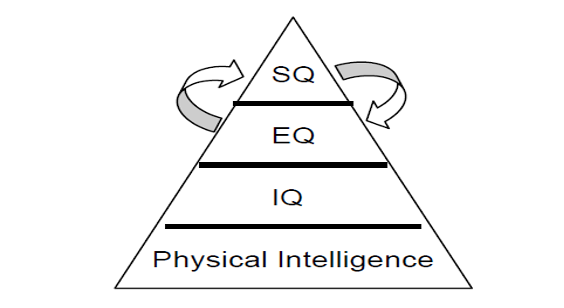 At the basic of human development is the mastery over controlling the physical body. This is base is associated with childhood development. Then one’s linguistic and conceptual skills develop. Wigglesworth (2011)’s third level of development is emotional intelligence. This is said to become a focus area when one realizes that they need to improve – usually based on feedback from social interactions. Lastly, Wigglesworth (2011) identifies spiritual intelligence as the fourth and final phase of human development. This phase, she argues, becomes a focus later in one’s life, as one begins to search for meaning and for life’s purpose.
Kisima takes this opportunity to invite you to reflect deeper on your own spiritual intelligence journey through the month of April 2022.
END
At the basic of human development is the mastery over controlling the physical body. This is base is associated with childhood development. Then one’s linguistic and conceptual skills develop. Wigglesworth (2011)’s third level of development is emotional intelligence. This is said to become a focus area when one realizes that they need to improve – usually based on feedback from social interactions. Lastly, Wigglesworth (2011) identifies spiritual intelligence as the fourth and final phase of human development. This phase, she argues, becomes a focus later in one’s life, as one begins to search for meaning and for life’s purpose.
Kisima takes this opportunity to invite you to reflect deeper on your own spiritual intelligence journey through the month of April 2022.
END
0 Comments